From Hive to Jar: How Raw Honey Travels From Texas Apiaries to Your Kitchen
I once drove 40 minutes to a warehouse with a trunk full of empty jars and paid a stranger in a polo shirt for 24 pounds of crystallized honey. Best money I spent that spring.
Raw honey has a route. It starts in a box on a trailer behind a ranch, makes a stop somewhere with a loading dock, and ends up on your toast. Most buyers never see the middle part, which is a shame, because the middle part is where good honey either survives or gets ruined. Here is how the trip actually works, and what to look at before you hand over your card.
Short version: raw honey is extracted cold, strained instead of filtered, and never pasteurized. Everything between the hive and your kitchen either protects that or undoes it. You can taste which one happened.
How does raw honey actually get out of the hive?
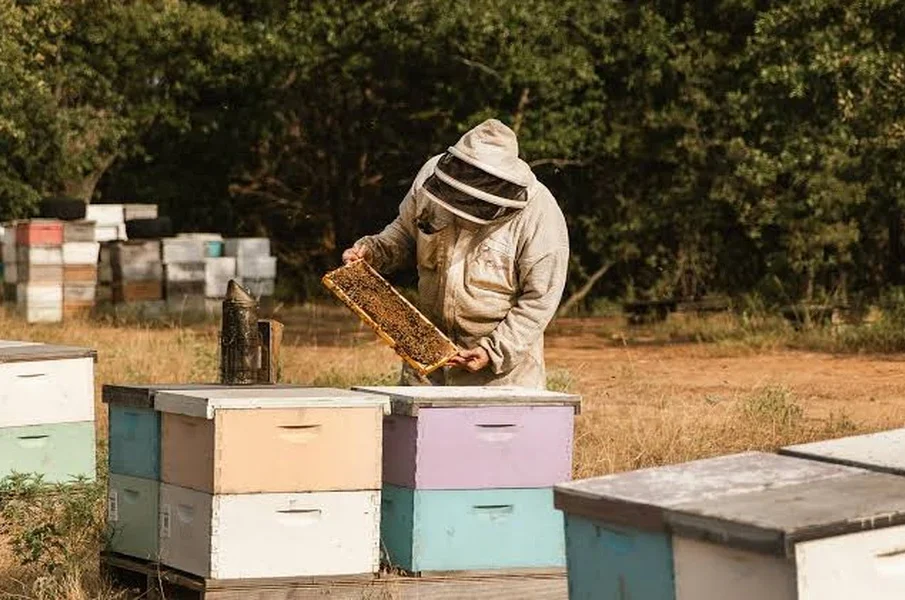
Bees cap a frame of honeycomb with a thin wax seal when the moisture drops low enough for the honey to keep. A beekeeper pulls that frame, uncaps it with a heated knife, and spins it in a centrifuge called an extractor. Gravity does the rest.
From there, the producer has three doors to walk through:
- Strain versus filter. Straining catches wax bits and bee parts with a coarse mesh. Filtration pushes honey through something fine enough to strip out pollen. Raw producers strain. Industrial bottlers filter.
- Heat or no heat. Commercial honey gets heated hard so it pours fast and stays clear on a shelf for years. Raw honey stays under roughly hive temperature or gets warmed gently at most.
- Glass or plastic. Glass holds flavor and can be warmed in a water bath when it crystallizes. Plastic is lighter to ship and cheaper to make.
That is the whole supply chain at its simplest: comb, extractor, strainer, jar. The steps multiply once volume goes up, because one person with twelve hives cannot jar every drop alone in a good season.
If you want to see how deep this rabbit hole goes, look at what the industry does to keep honey consistent. The USDA Agricultural Marketing Service runs programs that grade and classify honey, including color standards, because big buyers care about matching last year’s batch. Small raw producers mostly ignore all of that on purpose. Consistency is not the goal when the nectar source changes every few weeks.
The bulk problem, and why your jar came from a warehouse
Here is a number that reframes the whole thing. A strong colony in a good Texas season brings in surplus honey measured in gallons, not cups. Run that across hundreds of hives and you end up with drums. Then you need somewhere to put them.
Most small operations fall into three buckets. Some sell from the farm gate and never leave the county. Some ship individual jars straight from a shop. Some bottle at volume and move product through a central warehouse so it can be picked, packed, and shipped fast. That last model is how a jar of honey gets onto a doorstep in another state within a few days.
A warehouse is not a red flag. It is a logistics answer. The reason it matters to you is traceability. If the seller can tell you which region the honey came from and roughly when it was pulled, the warehouse is doing exactly what it should.
I asked a producer once why they did not just sell everything at a roadside stand. She laughed and said you cannot sell ten thousand pounds of honey to people who drive past once a week. The physical size of the harvest forces the business model.
What to check before you buy a jar
You do not need a lab. You need about ninety seconds and a short checklist:
- Flip the label. “Honey” alone is meaningless. You want a region, and ideally a season or a nectar source.
- Look at the texture. Crystallized honey is normal, not spoiled. Crystals actually tell you it was not over-processed. Warm the jar in a bowl of tap water if you want it pourable again.
- Check the pour test at home. Raw honey is thick. If it flows like syrup, it has been heated or cut.
- Read the price per ounce, not the sticker. A smaller jar at a fair unit price beats a bargain drum of the blended stuff.
- Ask where the bees were. Any producer worth buying from can answer this without checking a spreadsheet.
One warning. Honey labeled as a blend from multiple countries can legally be exactly that, with very little of it coming from anywhere near you. If local flavor is what you are after, buy from a producer who names a place.
When we switched our house jars, the top shelf of the pantry went through the fastest, which turned out to be the best storage lesson in the whole experiment. Cross-contamination is real, so keep a dedicated spoon if you like honey straight from the jar.
Where storage stops being about the pantry and starts being about physics
Honey is one of the most shelf-stable foods people keep in a normal kitchen, and the reason is boring and wonderful at the same time. Low moisture plus high acidity makes it hostile to most spoilage organisms. Store it sealed, at room temperature, out of direct sun, and it will outlast the jar’s label.
What kills honey quality is not time. It is heat and light. A jar sitting on a sunny windowsill for a summer will darken and flatten in flavor. Your pantry cabinet wins every time.
To understand why moisture content is the whole ballgame, the science sits in places like NASA, where food stability research runs into the same problem for astronaut meals. Water activity, not just water content, decides whether something keeps. That is why the wax cap on a frame is a signal, not decoration.
Shipping adds its own wrinkle. Honey in glass is heavy, and heavy costs money to move. That is part of why you see small jars from out-of-state producers priced where they are. It is not greed, it is freight.
One more practical note. Crystallization speeds up in cool rooms. If your husband finds your jar in the fridge and starts giving you a look, explain it kindly. Cold honey can still be warmed back to liquid without hurting it. Just avoid the microwave, which heats unevenly and can scorch the edges of the jar.
Buying direct, or buying through a storefront
Both work. The difference is what you are paying for. A farm stand gives you a conversation and a rough sense of the season. A dedicated online shop gives you inventory, packing, and shipping, which matters once you want the same jar every month.
Sweet Bee Gardens sits in Belton, Texas, and bottles around a honey category that leans on wildflower, orange blossom, and lemon sources from the state. You can browse the full lineup, including Texas honey delivered to your door, on their shop page. If you are curious about how the population side of this works, the U.S. Census Bureau keeps the demographic data that drives where food and farm businesses decide to build, and Texas has been a magnet for that growth for years.
Should you buy local? If you live near a small honey operation, yes, absolutely, go knock on the door. If you do not, an online retailer that names its state and sources its jars honestly is a fine second option, and often a better one than the mystery blend at the discount grocery.
What actually matters in your kitchen
Raw honey is a short list of steps done right: pull the frame, skip the hard heat, strain instead of filter, seal it in glass, and get it to somebody who will use it before it crystallizes. Everything else is logistics.
The next time you stand in front of a shelf with six honey jars, flip each one over. The label tells you more than the name of the bee on the front. Then go home and make something that needs a good pour. What is the first thing you are putting it on?